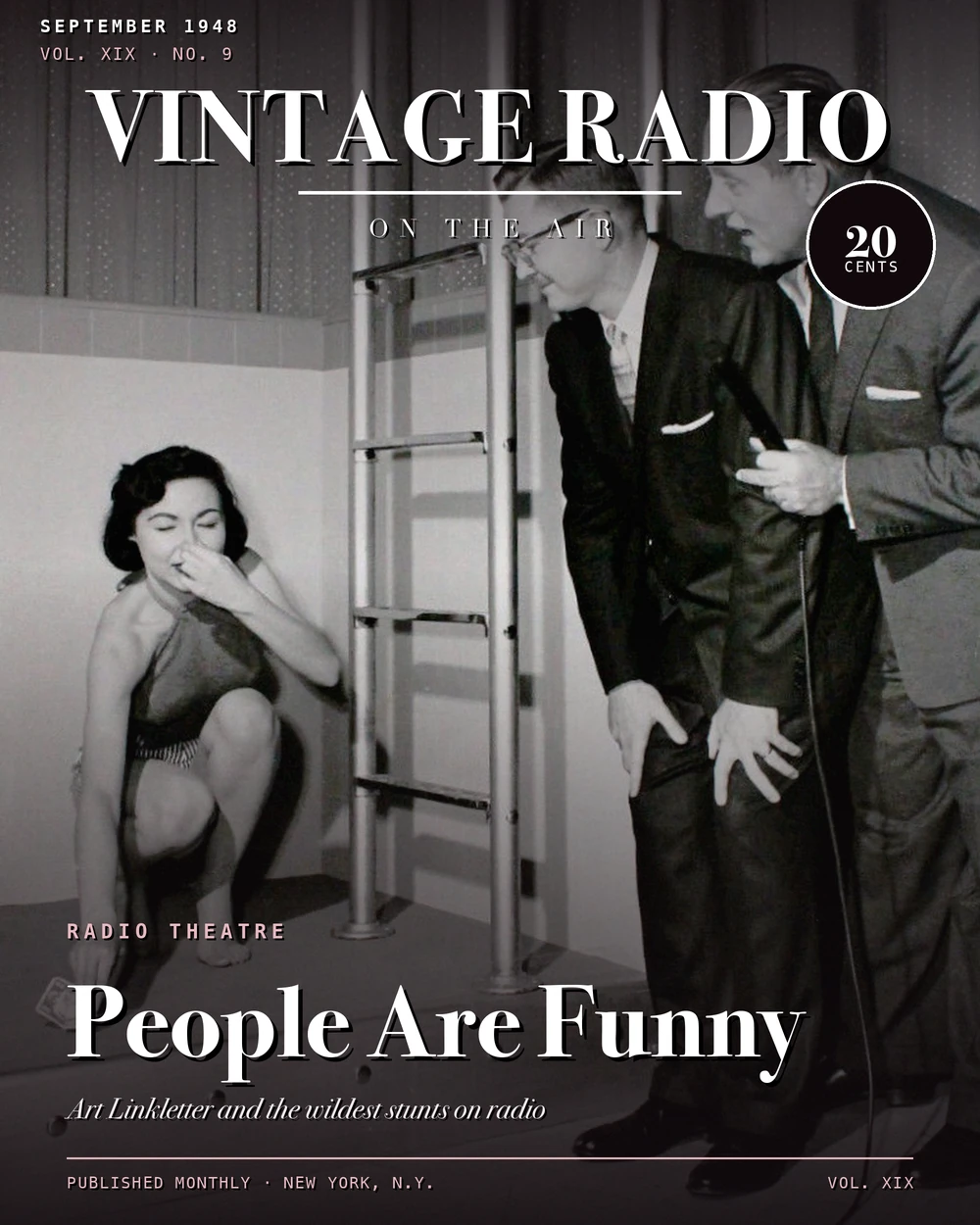
People Are Funny
How It Got on the Air
The story behind People Are Funny is almost as good as the show itself. John Guedel, the man who created it, had knocked around plenty before radio — digging ditches with the WPA, working as a traveling salesman, sleeping in parks and a graveyard during the lean years, accumulating more than 100 rejection slips from magazines before landing a writing job at Hal Roach Studios in 1933 on Laurel and Hardy and Our Gang comedies. He had the instinct for what was funny about ordinary people, and that instinct eventually became a show.
Guedel had the idea gestating for years. He made an audition record in 1938 at a cost of $30, and in 1939 tried a version called Pull Over, Neighbor on NBC and CBS outlets in Los Angeles. That one didn't take, nor did a subsequent revamp under the title All Aboard. The phrase that became the show's name came to him at a boring after-dinner speech, scribbled on a napkin. Then, in 1942, Guedel was sitting in a doctor's waiting room and read in a trade magazine that a radio show had just been canceled. He got on the phone, outlined the concept to the agency handling the account, and by the time the call was over, People Are Funny was going on the NBC Friday schedule. April 10, 1942 was the premiere date.
The Host Question
The show launched with Art Baker, described at the time as one of the best-known emcees on the Pacific coast. But Guedel had already met Art Linkletter — born Gordon Arthur Kelly on July 17, 1912, in Moose Jaw, Saskatchewan, and adopted as an infant by an itinerant evangelical preacher named Fulton John Linkletter. Linkletter had earned a teaching degree from San Diego State Teachers College in 1934, chose radio over the classroom because it paid better, managed programming for the San Francisco World's Fair from 1937 to 1939, and was doing well in San Francisco radio when People Are Funny launched. Guedel wanted him but couldn't get him in time.
His solution was to bring Linkletter in as cohost alongside Baker for the first two weeks, putting both men on the same soundstage so he could watch them work. The show caught on fast — by the end of its fourth month, it had been rated the second most popular quiz on the Pacific coast, and over its full run it would rival Truth or Consequences as radio's best-known audience stunt show. By the 78th week, Guedel had seen enough. Baker was out, Linkletter was in. Baker filed suit, claiming his contract could only be broken if the sponsor canceled the show outright and that Guedel and the sponsor had conspired to cancel it only to re-sign immediately with Linkletter at a lower salary. Baker never got the show back. From that point on, People Are Funny was Art Linkletter's show.
Linkletter's particular skill was the ad-lib, and it drew notice from people positioned to judge. Eddie Cantor and Bing Crosby both praised it. Collier's magazine noted that he had "a long list of basic questions that provoke laughter no matter how they are answered." His associates reportedly held their breath when he wandered close to risqué territory with contestants — he never stumbled. He had a set of standard questions for young brides — how they met their husbands, what happened on the first date, how they spent their honeymoons — and could get comedy out of almost any answer.
The Stunts
The show's premise was simple and durable: ordinary people were put into situations that revealed something absurd about human nature, and they won cash and merchandise for their trouble. What made it interesting was the architecture of the stunts, which Guedel and his writers designed with real care.
A signature device involved sending a contestant out into the city on a mission with assistant Irvin Atkins while Baker or Linkletter told the studio audience that the deck was stacked against them. Planted conspirators outside made the task harder and the contestant look more ridiculous. While the contestant was out, other games ran in-studio; when the contestant returned, they brought back the most interesting person they'd encountered. The formula gave the show two simultaneous tracks — the outside caper and the inside studio game — and the payoff came when the worlds collided.
The early stunts had a cheerful absurdity to them. In 1942, an aircraft worker was set up at Sunset and Vine with a naked mannequin, cloth, pins, and scissors and told to dress it on the spot. Another contestant was sent out with a pocketful of silver dollars to give away and could only unload three of them. A third, told to sell apples at "two cents each or two for a nickel," moved far more apples at two for a nickel. One stunt tied directly to the Kool Cigarettes sponsorship: a contestant took a penguin named Kenny Kool — the sponsor's mascot before Kool adopted Willie the Penguin — into Hollywood's finest clothing stores and tried to get the bird fitted for a sports coat. The season's most sensational stunt had a man attempt to check into the Knickerbocker Hotel with a trained seal he was passing off as his girlfriend.
The scale grew as the show did. In 1945, Linkletter had 12 small sealed boxes floated into the Pacific inside plastic balls, with a $1,000 prize for the first finder. That prize wasn't claimed for two years, when it turned up in the hands of a native of the Ennylageban Islands. In another stunt, a contestant was handed $20,000 to play the stock market for a week; the stocks gained more than $1,000, and the contestant kept the profit.
The Guedel and Linkletter Partnership
Guedel and Linkletter formed Guedel and Linkletter Productions in 1941, reportedly after a Hollywood Brown Derby lunch arranged by a Mutual Network executive who recognized that both men were independently developing audience participation shows with similar formats. Their partnership lasted 61 years and, according to a Linkletter tribute quoted in the Washington Post, was conducted without a signed contract and without a formal disagreement.
The weekly invention behind the show came out of a writing room that stayed loyal for the long haul. Johnny Murray was a writer and idea man in the early days, and Jackson Stanley joined around 1943 and stayed on staff for more than 13 years. Guedel's father Walter wrote for the show as well, making the operation something of a family business at the top. The announcing chores rotated among Herb Allen, Rod O'Connor, and Ted Myers.
Guedel was doing more than producing one show. He was also the creator of You Bet Your Life — the Groucho Marx quiz program — which had its origins in an early People Are Funny game in which contestants bet cartons of the sponsor's cigarettes on the outcome of stunts, with big winners going home with 30 or 40 cartons. He helped launch The Adventures of Ozzie and Harriet on radio in 1944, and the Guedel-Linkletter team also produced Earn Your Vacation, a summer replacement for Jack Benny that introduced a young Johnny Carson as host. Guedel eventually served as president of the Television Academy and became an early advocate for tape recording technology. During the 1950–51 season he introduced same-week repeat programming, running Tuesday's People Are Funny again the following Saturday night. The Saturday broadcasts pulled single-digit ratings on their own, but the combined weekly audience would have placed the show in the season's top five.
The Network Years and What Lasted
People Are Funny ran on NBC from April 1942 through May 1951, sponsored first by Wings Cigarettes, then Kool, then Raleigh Cigarettes and Sir Walter Raleigh Tobacco. It moved to CBS in October 1951, where Mars Candy came aboard as sponsor and the show settled into Tuesday nights at 8 — eventually ranking as Tuesday's top-rated program and placing in the season's Top Ten. It returned to NBC in October 1954 and ran in various time slots, sponsored by Toni and later by multiple sponsors, through June 1960.
A television version premiered September 19, 1954, with Linkletter continuing as host. It ran until April 1, 1960, received Emmy nominations in 1955 and 1956, and placed in the Nielsen top 30 for three consecutive seasons. NBC then aired encore TV episodes until April 13, 1961 — making People Are Funny the first game show to air repeats.
The show's reach extended beyond broadcasting. Paramount released a 93-minute musical comedy film also called People Are Funny on January 11, 1946, directed by Sam White and starring Jack Haley as a small-town radio producer, with Rudy Vallée, Ozzie Nelson, Frances Langford, and Helen Walker in the cast. Philip Reed played a fictionalized version of Guedel, while Linkletter appeared as himself — his feature film debut, according to Turner Classic Movies. Joe DeRita, later one of the Three Stooges, had a supporting role. Linkletter followed the film with a 1947 book of the same name, published by Doubleday with an introduction by Bing Crosby.
A British television version aired in 1955 with Derek Roy as host. A Warner Bros. cartoon from 1959, People Are Bunny, satirized the show: the Linkletter figure was renamed Art Lamplighter, the show was called People Are Phony, and Daffy Duck was the contestant. A revival hosted by Flip Wilson ran on NBC from March to July 1984. The show turns up in the background of Mad Men and in a Linkletter cameo in the Batman television series. The radio run itself generated relatively few preserved recordings — Guedel and Linkletter built the show around the unpredictability of ordinary people rather than celebrity appearances, which meant fewer reasons at the time to save the tapes.
The show has been described by radio and television historians as a prototype for the audience-participation contest format — a structural template that game shows have drawn on ever since. Whether or not that claim holds up to scrutiny, what's clear is that for 18 years, Guedel and Linkletter found ways to make ordinary people consistently funny, and audiences showed up for it week after week.